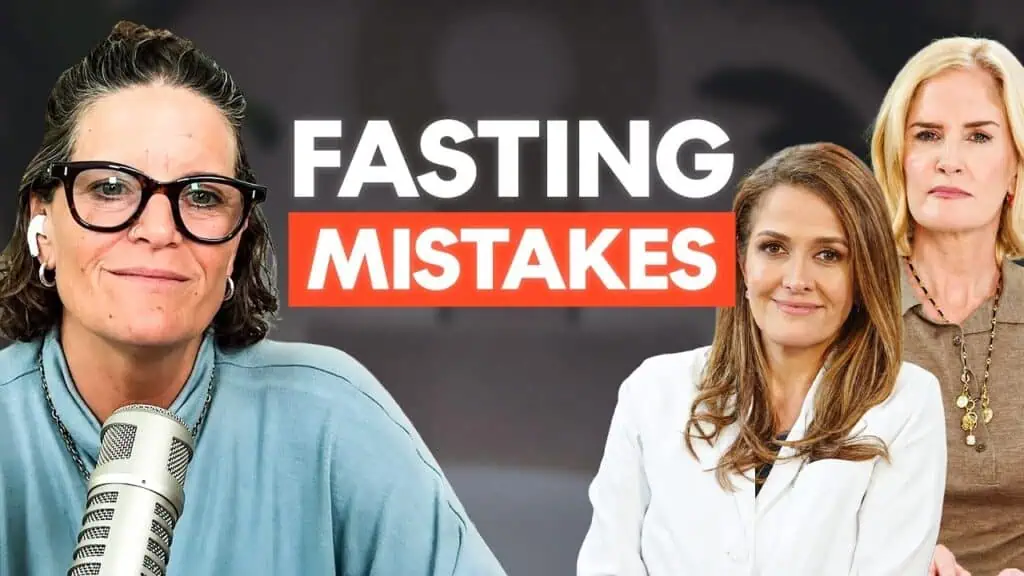
What is the biggest mistake we make when we talk about fasting for women?
We turn it into another test of discipline. We pick a number, whether that is 16 hours or 18 hours, and decide we should hit it every day, no matter what our bodies are telling us. If we feel worse, we assume we need to try harder.
Dr. Mindy Pelz Joins Dr. Thais Aliabadi and Mary Alice Haney to explain why that is exactly the mindset we need to question. Women are not simply smaller versions of men, and our hormonal lives are not static. A fasting routine that feels manageable during one part of the menstrual cycle may feel completely different before a period. What worked in our 30s may need adjusting during perimenopause.
The central idea behind Mindy’s approach is rhythm rather than rigidity. We need to consider when we eat, what we eat, our stage of life, and how we actually feel. Fasting is a tool to evaluate, not a rule we must obey.
Where did the interest in lifestyle and women’s health begin?
For Mindy, the starting point was a very personal experience. She was a scholarship tennis player at the University of Kansas when an injury was followed by profound exhaustion. At 19, she received a diagnosis of chronic fatigue syndrome and faced the possibility of being unable to return to school and competitive tennis.
After being offered a trial-and-error approach with medications, she consulted another practitioner who changed her diet substantially. She recalls eating meat and vegetables while removing bread, sugar, and fruit. Her energy returned within weeks, and she eventually returned to school and the court.
We should understand that as her individual experience, not a universal treatment for chronic fatigue syndrome. But it explains the question that shaped her career: if changing food could make such a difference in her life, what other roles could lifestyle play?
Her later work, grounded in her chiropractic training, included helping patients read food labels and navigate grocery stores. Education became as important to her as handing someone a plan.
What made Mindy rethink her original fasting recommendations?
We often hear success stories about fasting without hearing what prompted a practitioner to change course. In Mindy’s case, that turning point matters.
Her interest grew after learning about autophagy, the cellular recycling process associated with the work of Yoshinori Ohsumi, who received the 2016 Nobel Prize in Physiology or Medicine. She began introducing fasting in her practice, hoping to support the body’s own maintenance processes.
But she reports seeing some women develop troubling symptoms, including hair shedding, thyroid-related problems, and weight loss that stalled or reversed. Rather than simply extending their fasts, she started examining the menstrual cycle.
She recalls drawing the cycle on a large whiteboard and looking at estrogen, progesterone, and testosterone alongside eating patterns. Her practical observation was that some women did better when they stopped fasting during the week before their periods.
Those observations helped shape her fasting-cycle framework. They are clinical anecdotes, however, rather than proof that a particular schedule prevents thyroid problems or hair loss.
Why does the week before our period feature so prominently in this approach?
We need to stop treating every week of the month as metabolically interchangeable. Mindy describes estrogen and progesterone as related hormones with very different personalities, and she places particular emphasis on providing enough nourishment during the progesterone-dominant part of the cycle.
In her framework, the week before a period is a time to step away from fasting and strict ketogenic eating. Instead, we bring back carbohydrate-containing whole foods and stop interpreting increased appetite as a character flaw.
That emotional piece is important. How many of us have craved carbohydrates before a period and immediately labeled ourselves undisciplined? We can notice a pattern without turning it into a judgment.
Mindy explains this through progesterone’s relationship with glucose. We should treat that explanation as her rationale for the method, not as evidence that eating a particular fruit will directly increase progesterone. The broader message is to make room for changing nutritional needs rather than overriding them.
How are metabolic health and hormonal health connected?
We cannot have a useful conversation about hormones while ignoring insulin and blood sugar. That connection runs through the discussion of PCOS, midlife weight changes, and menopause symptoms.
Dr. Aliabadi explains that when the body becomes less responsive to insulin, it may produce more insulin to compensate. Elevated insulin can influence ovarian hormone production, including androgen production in PCOS. That helps explain why addressing metabolic dysfunction can sometimes improve more than weight alone.
We may see changes in menstrual regularity, acne, excess facial or body hair, and other symptoms when the underlying metabolic picture improves. The point is not that every hormonal symptom has one cause. It is that treating each symptom separately can leave an important connection unexplored.
For a broader look at sustainable nutrition and movement, we can build on these ideas with our guide to diet and exercise for PCOS. Fasting is only one possible part of that larger conversation.
Does fasting directly balance hormones, or are the benefits related to improved insulin sensitivity?
We need to ask that question carefully, because these are not identical claims. Dr. Aliabadi presses the distinction: does fasting itself directly change reproductive hormones, or can improved insulin sensitivity and changes in metabolic health help explain the improvements?
Mindy’s answer ultimately returns to overall health. She sees improvements in weight and metabolic markers as signs that the body is functioning better, with hormonal improvements potentially following.
She also mentions research involving women with PCOS who used approximately 15-hour daily fasts and experienced symptom improvements. However, she does not provide the study’s sample size or detailed results in the conversation. We therefore cannot use that reference to establish an ideal fasting duration or recommend it for everyone with PCOS.
The useful distinction is this: a plausible metabolic pathway is not the same as proof of a universal hormone-balancing protocol. We can remain interested without pretending the unanswered questions are settled.
Why does Mindy focus so much on hemoglobin A1C?
We can become so focused on the scale that we miss the broader metabolic picture. Mindy repeatedly returns to hemoglobin A1C as a marker she uses to orient that conversation.
She describes a personal clinical goal of moving A1C toward approximately 5.0%, especially before women enter the more hormonally unpredictable years of midlife. In her experience, improvements in that marker often accompanied improvements elsewhere.
We should keep the distinction between her preferred target and an individualized medical target. The conversation does not establish that every woman needs an A1C of 5.0%, or that reaching that number will resolve menopause symptoms.
What we can take from her emphasis is the value of asking better questions. Rather than asking only whether we have lost pounds, we can ask whether our eating pattern is supporting metabolic health, whether our symptoms are improving, and how our clinician interprets our laboratory results alongside our history.
What does “metabolic switching” actually mean?
We can think of metabolic switching as changing the balance of fuels our bodies use. After eating, glucose is an important source of energy. During a longer interval without food, the body increasingly draws on stored energy, and the liver can produce ketones from fat.
Mindy uses a simple contrast between a glucose-fueled state and a fat-burning state to make this understandable. She often places the beginning of that shift around 12 hours without food.
We should not interpret that as a precise timer that works identically for everyone. Her explanation is a simplified model of a complicated system, not a guarantee that a particular metabolic event occurs at exactly the twelfth hour.
The practical reason she emphasizes the concept is to broaden nutrition beyond food choices alone. We can consider both what we eat and when we eat, without turning either into an all-or-nothing identity.

Where should we start if we are curious about intermittent fasting?
We start with food, not with a heroic fasting window. That is one of the most useful points in Mindy’s approach.
Her first priorities are straightforward:
- Move away from ultra-processed foods.
- Include protein at every meal.
- Bring in fiber-rich foods.
- Choose whole-food carbohydrate sources rather than relying on refined carbohydrates.
- Include fats such as olive oil.
Only then does she suggest practicing a modest overnight interval, such as 12 hours. We do not need to jump straight into skipping breakfast until noon or attempt a long fast because someone else finds it easy.
She describes staying with that shorter interval for weeks, potentially a month, before even considering a longer window. The spirit of that advice is gradual adaptation. We are not behind if our starting point looks ordinary, and we do not earn extra credit by making eating more difficult.
What if we feel hungry, dizzy, irritable, or exhausted?
We should not treat feeling terrible as proof that a plan is working. During the conversation, Dr. Aliabadi describes being genuinely hungry in the morning after an early dinner, even when the overnight interval is only 13 or 14 hours.
Mindy explains that some people find fasting easier as they become more accustomed to using different fuel sources. She associates ketones with reduced hunger and greater mental clarity.
But we need to separate that proposed explanation from the decision in front of us. Persistent dizziness, significant irritability, worsening fatigue, or other concerning symptoms are not a challenge to overcome for the sake of a number.
The message that runs through the interview is to adjust rather than double down. We can shorten the interval, reconsider food intake, and bring concerns to a medical professional. A routine that leaves us feeling worse deserves reassessment, not a lecture about willpower.
How does Mindy organize fasting across a regular menstrual cycle?
We first need a shared definition of day one: the first day of menstrual flow, rather than the days of light spotting that may precede it.
Using a roughly monthly cycle as an illustration, Mindy describes four broad phases:
- Days 1 through 10: Her framework allows more flexibility with fasting and lower-carbohydrate eating, depending on tolerance.
- Approximately days 11 through 15: Around ovulation, she favors shorter fasts and more whole-food carbohydrates.
- Approximately days 16 through 19: She describes another interval when some women may tolerate more fasting.
- Approximately day 20 until the next period: She recommends stopping fasting and stepping away from ketogenic eating.
We should not mistake these illustrative dates for a universal calendar. Mindy acknowledges that cycles may be 24 days, 32 days, or another length entirely. Her schedule is also a proposed framework, not an established requirement for menstrual health.
The important shift is paying attention to our own pattern instead of forcing every body into the same monthly template.
What changes during perimenopause?
We lose the convenience of a predictable calendar. A cycle may arrive much sooner than expected, stretch for weeks, or become difficult to interpret. That makes a rigid day-by-day fasting schedule less useful.
Mindy’s approach during perimenopause is to let symptoms carry more weight. She specifically mentions spotting, anxiety, and insomnia as reasons to reduce fasting and reconsider nourishment, including carbohydrate intake.
Later, she suggests that some women may become comfortable with a 15-hour interval. But we need to read that alongside her repeated emphasis on individualization, not as a blanket prescription.
We also should not assume that a new symptom is simply a fasting problem. The practical next step is a fuller conversation about what is happening. Our menopause and perimenopause resources can help us recognize the range of symptoms worth discussing with a clinician.
Perimenopause is not the time to insist that yesterday’s routine must work today.
Should we avoid fasting in midlife because of cortisol?
We hear two competing absolutes: every woman should fast, or no woman in midlife should fast because it raises cortisol. Mindy pushes back on the second statement without arguing that more fasting is always better.
Her answer is that we need to consider the person, the symptoms, and the timing. If cycles become erratic or anxiety and sleep problems worsen, her recommendation is to back off rather than extend the fasting window.
The conversation does not establish one cortisol response that applies to every woman. It also does not provide a test that tells us exactly how long to fast.
What we can do is stop arguing with our experience. If a schedule feels restorative for one person and depleting for another, that difference matters. We need a plan that fits our current biology and daily life, not a universal slogan.
How does the conversation change after menopause, including when we take progesterone?
We no longer have a menstrual cycle to use as the organizing framework. Mindy describes relying more on tolerance and perceived benefits, particularly mental clarity.
Her own comfortable interval is generally 15 to 17 hours. She also reports that some postmenopausal women in her community feel better with similar windows. Those are personal and community experiences, not evidence that postmenopausal women should automatically fast longer.
When asked about taking progesterone at night, Mindy says she takes it herself and still fasts. We should understand that as her experience, not as a medication-specific recommendation for everyone receiving hormone therapy.
For a wider discussion of individualized treatment, nutrition, and hormones, we can explore our clinical guide to menopause, nutrition, and hormone therapy. Meal timing belongs within that larger care plan rather than replacing it.
What are “hormone feasting foods,” and do we need to fear carbohydrates?
We do not need another reason to be frightened of fruit. Mindy created the phrase “hormone feasting foods” partly to counter the fear of carbohydrates that became common in ketogenic-diet communities.
Her examples include tropical fruits, squash, and legumes. In her framework, these foods become especially relevant when she recommends reducing fasting and increasing nourishment before a period or in response to perimenopausal symptoms.
The phrase is her teaching language, not a formal medical food category. We should not interpret it as a promise that a serving of squash will correct a hormone deficiency.
What makes the idea useful is the permission it gives us to stop treating all carbohydrates as interchangeable. We can discuss whole fruit, beans, and vegetables differently from refined snack foods. We can also recognize that eating enough is part of caring for our bodies, not a failure to follow a plan.
How should we eat during the eating window?
We still need to nourish ourselves. A shorter eating window does not make food quality irrelevant.
Mindy gives an example of opening her eating window at noon and finishing around 7 p.m. Within that seven-hour period, she suggests two meals and a snack as a practical structure. That might mean lunch, something in the afternoon, and dinner.
Her concern is less about a planned snack than about grazing continuously without noticing. She argues that repeated eating can keep the body repeatedly responding to incoming food, including through insulin secretion.
We do not need to turn that into a prohibition against every snack. The useful question is whether our pattern is intentional and satisfying or whether we are picking at food all day without eating proper meals.
We can plan around our work and exercise schedules while keeping the same foundation: protein, fiber, whole foods, and enough nourishment.
What can we drink while fasting, and where do minerals fit?
We can keep the everyday version simple. Mindy includes water, mineral water, unsweetened herbal tea, and plain coffee among her options. She emphasizes avoiding sweeteners and sweetened coffee additions.
She also discusses experimenting with bone broth during some fasting routines. We need to recognize that this is a modified approach, not the same thing as a water-only fast. The definition matters when we discuss what someone is actually doing.
For minerals, she mentions sodium, potassium, and magnesium, particularly in connection with longer fasts. The interview does not provide individualized doses, so we should not treat that list as a supplement prescription.
Alcohol, in her approach, belongs outside the fasting interval. Even then, she recommends moderation and highlights the liver’s role in metabolism. We do not need to turn a discussion of temporary relaxation into an argument that alcohol is a health tool.
What is a sensible first meal after a fast?
We want to think about what we are adding back, not simply how long we managed to go without food.
Mindy’s preferred starting food is bone broth, with vegetable broth as another option. She then emphasizes fiber-rich foods such as salad or microgreens, protein, and olive oil.
She likes the idea of approximately 30 grams of protein in the first meal. We can understand that as her practical suggestion rather than a number that defines success for every person.
The broader pattern is more important than any single ingredient: a nourishing meal with protein, plants, and fat. When asked about foods she personally avoids, she names conventional hot dogs and doughnuts. Her emphasis throughout is on moving away from heavily processed choices.
We do not need a perfect ceremonial meal. We need to avoid making fasting the entire project while treating the food that follows as an afterthought.
How should we interpret claims about autophagy and longer water fasts?
We need to separate interest in a biological process from certainty about a home protocol. Mindy connects longer fasting windows with autophagy and discusses 24-hour fasting in relation to intestinal repair. But the interview does not establish precise human timelines or demonstrate that a particular number of hours guarantees those outcomes.
She also describes doing a three-day water fast annually for personal and spiritual reasons, alongside a large community event. Her emphasis during those days is rest, reflection, and not exercising.
We should not turn that personal practice into a general recommendation. An overnight eating interval and three days without food are very different decisions.
Likewise, the brief mention of fasting around chemotherapy is not a treatment protocol. We need to make decisions involving cancer care with the treating oncology team, not infer instructions from an anecdote.
Longer is not automatically better, and a suggested benefit is not a guarantee.
What is the connection between ketones, mental health, and the menopausal brain?
We often discuss menopause as though it affects only the ovaries. Mindy wants us to pay attention to the brain as well.
She draws on conversations with neuroscientist Lisa Mosconi about changes in brain energy use during menopause, and with psychiatrist Georgia Ede about ketogenic approaches in mental health. Her interest is whether ketones could serve as a useful alternative fuel in that context.
There is an important limitation within the conversation itself: when Mindy describes asking about research specifically on ketones and the postmenopausal brain, she acknowledges that the direct research question had not yet been answered.
We therefore should not translate this discussion into a claim that fasting prevents dementia or treats depression, anxiety, or schizophrenia. The useful takeaway is curiosity about the relationship between metabolic and brain health, while keeping mental health treatment and medical evaluation firmly in the picture.
Why describe menopause as an opportunity rather than a decline?
We spend a lot of time hearing what women supposedly lose with age. Mindy wants to widen that story.
She discusses anthropologist Kristen Hawkes and the grandmother hypothesis, an evolutionary explanation that emphasizes the contribution of older women to the survival of families and communities. In that account, post-reproductive life has value through food gathering, caregiving, knowledge, and social connection.
For Mindy, the powerful idea is that our purpose does not disappear when reproduction ends. She connects that perspective with the possibility of greater confidence, clearer boundaries, and leadership in later life.
Some of her language about the brain removing people-pleasing circuitry is best understood as her interpretation of a broader adaptation story, not a literal neurological promise.
We can embrace the hopeful message without minimizing difficult symptoms. Menopause may require treatment and support, and it can still mark the beginning of a meaningful new phase.
What everyday habits does Mindy suggest for supporting mood and engagement?
We do not have to make every brain-health conversation about fasting. Some of Mindy’s most accessible suggestions involve how we spend our days.
She emphasizes novelty: rearranging furniture, learning an activity, or taking a different route to the grocery store. Her point is to keep inviting new experiences rather than allowing life to narrow into the same routines.
She also values storytelling. With her 86-year-old mother, she asks for new details within familiar stories instead of dismissing a story because it has been told before. That creates connection while keeping the conversation active.
Daytime walks are another suggestion. We can take the practical invitation to move and spend time outdoors without treating her simplified explanations of individual brain chemicals as guaranteed effects.
The larger question is appealing: what can we bring into our lives that is new, social, interesting, or meaningful? Our health is bigger than a meal schedule.
What should we carry forward from this conversation?
We should carry forward permission to pay attention. Not permission to ignore medical care, and not pressure to adopt a more demanding fasting routine.
Mindy describes the desired outcome as freedom: less fixation on calories, less fear of food, and greater appreciation for our bodies. That gives us a useful standard for evaluating any plan. Is it helping us feel more capable and informed, or is it creating another set of rigid rules?
We can begin with nourishing food, consider meal timing cautiously, notice changes across our cycle or stage of life, and discuss symptoms with a qualified clinician. We can also acknowledge where personal observations end and stronger evidence is still needed.
The goal is not to become better at ignoring our bodies. The goal is to understand them well enough to respond.
This conversation is educational and does not replace individualized medical advice. We should make decisions about fasting, supplements, hormone therapy, and treatment with our own healthcare professionals.
Concerned About Your Health? Talk to Dr. Aliabadi
Dr. Aliabadi is an expert OB/GYN who is knowledgeable in all aspects of women’s health and well-being. Dr. Aliabadi and her caring, supportive staff are available to support you through PCOS, endometriosis, menopause, childbirth, infertility, or routine gynecological care. <br><br> We invite you to establish care with Dr. Aliabadi. <br>Call us at (844) 863-6700 or