Table of Contents
- Why we held this panel and what we want you to walk away with
- Who spoke and why their perspectives matter
- Core themes you should remember
- Interview
- Resources and next steps
- Short checklist to bring to your next appointment
- FAQ
- Final notes from our panel
Why we held this panel and what we want you to walk away with
We gathered in New York City during Breast Cancer Awareness Month to push the conversation forward: early detection, smarter screening, and how each of us can act now to lower risk and save lives. Our panel included a survivor who turned her diagnosis into advocacy, leading clinicians who treat breast cancer every day, a journalist who launched a coalition to accelerate cancer vaccines, and experts working on AI tools that change how we predict risk.

Who spoke and why their perspectives matter
- Olivia Munn — actress, survivor, and advocate. Her decision to get a lifetime risk assessment led to imaging that found an aggressive cancer at an early stage.
- Dr. Thaïs Aliabadi (Dr. A) — OBGYN, surgeon, and Olivia’s doctor. She explains how to calculate lifetime risk and design a screening plan tailored for each woman.
- Dr. Shari Goldfarb — oncologist at Memorial Sloan Kettering. She leads trials to improve survivors’ quality of life and explain modern treatment advances.
- Kristen Dahlgren — journalist turned founder of the Cancer Vaccine Coalition, working to accelerate therapeutic and preventive cancer vaccines.
- Donna McKay — CEO of the Breast Cancer Research Foundation, who helped explain a newly FDA-approved AI mammogram tool, Clarity Breast.
Core themes you should remember
- Know your lifetime risk score. It is simple to calculate and changes how your screening should look.
- Mammograms save lives but are not perfect. Dense breasts and younger age can hide cancers on standard mammograms.
- Supplemental imaging matters: 3D mammography, ultrasound, and MRI each have a role depending on risk and breast density.
- Genetic testing is actionable. If you have a family history of breast, ovarian, pancreatic, or related cancers, ask about testing.
- New tools are here: AI is turning mammograms into predictive tests and may guide future individualized prevention and vaccines.
- Emotional and practical survivorship care is part of modern medicine. You are not alone in managing fear, side effects, or fertility and career concerns.
Interview
Olivia — tell us the moment you decided to act, and what the lifetime risk assessment actually changed for you.
Olivia: We were focused on routine care. After having my first child, I was checking things off the list. I had a normal mammogram and ultrasound, but I also took the lifetime risk assessment tool, and it returned a 37.3 percent lifetime risk. Anything above 20 percent is considered high.
That single number changed the pathway. Even though my mammogram and ultrasound were read as clear, my high score prompted an MRI. The MRI found something the mammogram did not. From that MRI came an ultrasound and multiple biopsies. The result: stage one, luminal B, multifocal disease. Later, a surgical review even found additional disease in the opposite breast, making it bilateral and multifocal.
That score didn’t just identify my need for more testing. It changed the urgency and the approach. It meant the difference between routine annual surveillance and a targeted imaging plan that ultimately found cancer early enough for curative treatment.
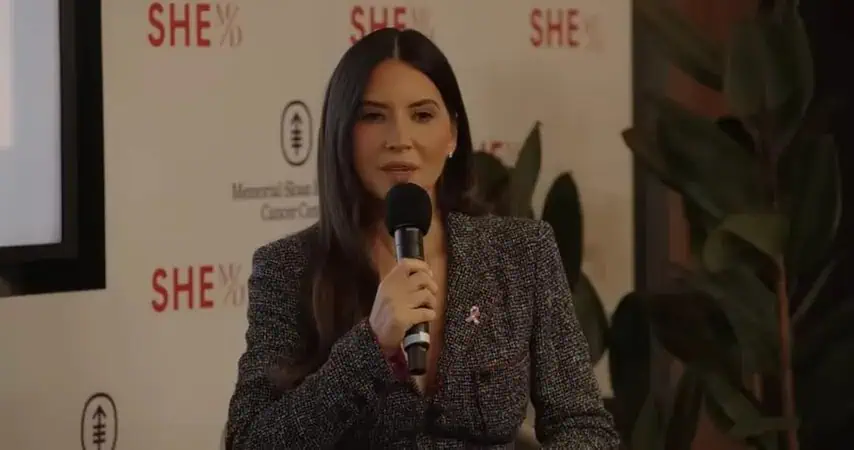
Dr. A — What is the lifetime risk assessment, and how do we use it?
Dr. A: The tool we most commonly use is Tyrer-Cuzick. It asks simple questions: age, age at first period, age at menopause if relevant, family history, prior breast biopsies, and breast density. Plug that information in, and you get a lifetime percentage. If the number is 20 percent or greater, we call that high risk.
Knowing this percentage allows us to design screening that fits the woman, not the calendar. For example, a woman with a 25 percent lifetime risk may need screening that starts years earlier than age 40. She might need 3D mammography, ultrasound, and, for high-risk patients, an MRI every year. Mammograms detect roughly 80 percent of cancers, but they can miss lesions in dense breasts. That is why layered screening is crucial.
How often do mammograms miss cancers, and why does breast density matter?
Dr. A: Mammograms still save lives. But mammograms are less sensitive in dense breasts. Dense glandular and fibrous tissue appears white on an X-ray, the same color as many tumors. That makes small lesions hard to distinguish. Younger women naturally have denser breasts, which is one reason we should avoid a blanket “start at 40” rule. Instead, start screening based on personalized risk.
If your mammogram report mentions “dense breasts,” don’t let that line sink into the paper. Ask what it means for your screening plan. For moderate to high density, we order tomosynthesis, or 3D mammography, because it reads the breast in thin slices and reduces the masking effect. We often add ultrasound and, for high-risk, MRI.

Kristen — you launched the Cancer Vaccine Coalition. What is a cancer vaccine, and why now?
Kristen: The concept is straightforward: train the immune system to recognize tumor-specific proteins. A therapeutic vaccine primes immunity to target cancer cells and then creates immune memory, so the body can surveil and eliminate microscopic disease before it grows into clinically significant recurrence.
Right now the science is better than ever. AI can analyze a tumor and help select which antigens to target. Trials exist in pancreatic cancer and glioblastoma with promising signs. The goal is recurrence prevention in the near term and, one day, primary prevention for high-risk people. Funding and collaboration across centers are major bottlenecks. The coalition brings leading centers together to share data and accelerate trials.
Dr. Goldfarb — How has treatment advanced in the last decade, and what does that mean for someone diagnosed today?
Dr. Goldfarb: We have more FDA-approved breast cancer therapies now than for any other single cancer in the last decade. That means better outcomes across subtypes, and more options for targeted therapy and immunotherapy.
For many patients with metastatic disease, survival has extended to years or decades rather than months. For early-stage disease, cure rates remain high. Equally important, we pay more attention than ever to quality of life: fertility preservation, sexual health, hot flashes, cognitive effects, and career impact are part of survivorship planning. Young patients, in particular, need coordinated care so appointments and interventions don’t tear their lives apart.
Donna — tell us about Clarity Breast and how AI is changing prediction.
Donna McKay: One of the exciting advances is repurposing mammograms as predictive tools. The Clarity Breast AI tool, developed with thousands of mammogram images, can predict up to five years in advance who is likely to develop cancer. This is a paradigm shift: a diagnostic image becomes a predictive one. It has received FDA approval and adds another layer to the personalized screening toolkit. That means we could identify higher-risk patients earlier and tailor follow-up imaging and prevention strategies.

How do genetic tests fit into all of this? Who should be tested, and when?
Dr. A: Genetic testing is a key piece. While most breast cancers are not linked to a single inherited mutation, when you have a close relative with breast, ovarian, pancreatic, or certain other cancers, you should consider testing.
General guidance: if you have a strong family history, testing can be done earlier. For many people, age 25 is a sensible starting point for genetic testing if family history suggests risk. For risk assessment calculation and broader screening planning, we recommend knowing your lifetime risk by age 30 at the latest.
Keep in mind that some mutations can be hidden in families if they are passed through male relatives. That is why a detailed family history—and sometimes testing even without a clear family history—may be recommended.
When should someone consider prophylactic surgery like a bilateral mastectomy?
Dr. A: This is intensely personal. For some women, a 25 percent lifetime risk after watching a family member suffer is too much. For others, even an 80 percent risk from a BRCA mutation may be a risk they are willing to accept. The important thing is informed choice.
We want every woman to know her options: surveillance with MRI and alternating ultrasound and mammography every six months, chemoprevention, or risk-reducing surgery. Our role is to present the data, explain the pros and cons, and support the decision she makes. Some patients choose prophylactic surgery to reduce anxiety and the need for intensive surveillance; others prefer conservative monitoring. Both are valid when the choice is informed.
Olivia — What were the emotional moments, and how did you get through them?
Olivia: For much of my treatment, I was in “mama-bear” mode. With a one-year-old at home, I had no time to be paralyzed by fear; I had to act. Still, the night before surgery, the fear hit. I worried about whether I had kissed my son enough, whether I would be there for him. My doctor, Dr. A, was calm and direct. She reminded me that removing the tissue was the right medical choice and that we were putting together the best care plan. That steadiness gave me the space to process my feelings and then move forward.
Now, when life gets overwhelming, I use a simple trick. I imagine my 80-year-old self being offered my current life again. If that older me would give anything to return to this messy, loud, imperfect moment, then I put my phone away, look at my child, and live that second fully. It brings perspective and eases the daily weight of fear.
How do we manage the fear of recurrence? It’s constant for many survivors.
Olivia: Anxiety is real. Small aches become alarms in our minds. For me, community helps. When others tell us they understand, it helps carry the weight.
Dr. Goldfarb: Face the fear, name it, and build a toolbox. For most women with early-stage disease, a cure is likely. That reality coexists with worry. Practical strategies include scheduled surveillance (so your alerts aren’t constant), mental health support, peer groups, and staying active in your care—know when to call your team. The large majority of patients with stage 0 to 3 disease do well long term, and supportive medicine is getting better at managing treatment side effects and anxiety.
What about young adults who are diagnosed in their 20s? Screening guidelines can feel irrelevant to them.
Dr. A: This is one of the most urgent gaps. We do not screen everyone in their 20s, but if there is a family history or a known pathogenic variant, screening should begin 10 to 20 years earlier than the youngest affected relative. For example, if a mother was diagnosed at 35, we start screening at 15 to 25.
For sporadic young diagnoses without family history, the problem is detection: younger women are often diagnosed when they find a lump because routine imaging is not yet standard. The hope is that AI predictive tools and eventual vaccine or preventive strategies will help close this gap.
Kristen — How much would it take to bring a cancer vaccine to market?
Kristen: The physicians and researchers I spoke with estimate that with coordinated effort and funding—less than a billion dollars in aggregated, strategic investment—we could push meaningful vaccine candidates through trials. That figure requires cross-institutional collaboration and government and philanthropic support. We spend tens of billions annually on cancer care. Investing smartly in prevention and immune-based strategies could change the cost and the human toll of this disease.
How is AI used beyond prediction—can it personalize vaccines or identify targets?
Kristen: Yes. AI can analyze tumor sequencing data to highlight which neoantigens are most likely to generate an immune response for a given patient. That enables personalized vaccines. For off-the-shelf approaches, AI helps identify shared targets across patients. The technology is a catalyst—data, samples, and funding still drive real-world progress.
How do we translate these insights into routine care? Any policy ideas?
Olivia: One of our next steps is legislative: making lifetime risk assessment part of standard intake. When we go to the doctor, we already share age, pregnancy history, and blood pressure. Why not lifetime risk? We’re working with allies in Washington to propose making it a routine part of care so that women don’t have to discover it themselves.
Dr. A: Normalizing the risk assessment takes the burden off patients and forces the clinical system to offer tailored screening. That will save lives because many women do not know which tests they need or that they even have dense breasts.
What practical screening strategies should we all know about?
- Low risk: follow guideline-based mammography, ideally 3D tomosynthesis.
- Intermediate risk (lifetime risk 15–20 percent): consider starting imaging earlier, for example, at age 35, and discuss supplemental ultrasound or MRI depending on family history.
- High risk (20 percent or greater): annual MRI plus 3D mammogram and ultrasound as indicated. Genetic testing, if not already completed.
- Young women with symptoms: do not delay. If you find a change, insist on prompt evaluation regardless of age.
Resources and next steps
Here are practical actions every woman and ally can take today:
- Calculate your lifetime risk using a validated tool such as Tyrer-Cuzick. If your score is 20 percent or higher, ask for a high-risk screening plan.
- Read your mammogram report for the term “dense” and bring that up with your clinician.
- Discuss genetic testing if you have relatives with breast, ovarian, pancreatic, or early-onset cancers. Consider testing by age 25 when indicated.
- Ask whether 3D mammography, ultrasound, or MRI is recommended for you based on risk and density.
- Support research—funding for vaccine trials, AI tools, and large collaborative studies accelerates progress.
- Build a survivorship plan: fertility counseling, mental health support, sexual health, and menopausal management are all part of quality care.
Short checklist to bring to your next appointment
- Bring your lifetime risk percentage or ask to calculate it during intake.
- Ask about breast density listed on prior mammograms.
- If you have a family history, request genetic counseling and testing if appropriate.
- Ask which type of mammogram is being ordered—2D or 3D tomosynthesis.
- If high risk, confirm whether annual MRI is part of your plan.
FAQs
Who should calculate a lifetime risk assessment, and how long does it take?
Every woman who knows her name and date of birth should consider calculating her lifetime risk. The Tyrer-Cuzick test and similar calculators are free online and take minutes to complete. The result informs when and how to start screening and whether supplemental imaging is needed.
What is breast density, and how does it affect screening?
Breast density refers to the proportion of glandular and fibrous tissue compared with fatty tissue. Dense tissue appears white on a mammogram and can mask cancers that also appear white. Density is listed on mammogram reports. If you have dense breasts, ask about 3D mammography and supplemental imaging like ultrasound or MRI.
If my mammogram was clear, why would I need an MRI?
A mammogram is an excellent screening tool, but it does not detect every cancer, particularly in dense breasts or in fast-growing subtypes. An MRI is more sensitive and can find lesions missed by a mammogram and ultrasound. For women with high lifetime risk, an MRI is often recommended annually.
When should I get genetic testing?
If you have a strong family history of breast, ovarian, pancreatic, or related cancers, consider genetic testing. In many cases, testing by age 25 is appropriate when there is a known family mutation or early-onset cancer in relatives. Genetic counselors help interpret results and guide preventive options.
Are cancer vaccines realistic, and what would they do?
Therapeutic cancer vaccines aim to train the immune system to recognize and destroy residual cancer cells and prevent recurrence. With advances in genomics and AI-driven antigen selection, the science is more mature than ever. Trials are underway, and early investments could accelerate availability in the coming years.
How can I manage fear of recurrence?
Build a support network, schedule surveillance so you have structured follow-up rather than daily worry, access mental health care, and connect with survivor groups. Ask your clinical team about strategies to manage treatment side effects and to optimize quality of life. For many, targeted therapy and survivorship programs reduce anxiety over time.
What can I do if I want to reduce my personal or my family’s risk?
Start with information: calculate lifetime risk, review family history, and pursue genetic testing if indicated. Modify lifestyle factors where possible—maintain a healthy weight, limit alcohol, stay active—and follow a screening plan tailored to your risk. Discuss preventive options with specialists when your risk is high.
Final notes from our panel
We left that day with the Empire State Building glowing pink and a reinforced belief: actionable information plus coordinated care saves lives. We can make tangible changes right now—calculate your lifetime risk, read your mammogram report, and talk to your clinician about the right imaging for you. At the same time, we can accelerate research into vaccines and AI-driven prevention so that fewer people face the fear and disruption breast cancer brings.
We are committed to continuing this work, to pushing for lifetime risk to become a routine part of medical intake, and to supporting research that brings less toxic, more precise prevention and treatment. If you have questions, share your story with clinicians and patient advocates. Knowledge changes outcomes, and together we move the needle toward prevention, earlier detection, and better lives.
For a list of organizations and tools mentioned, visit the resources included in our conversation. Calculate your lifetime risk, ask the hard questions at your next appointment, and know that the community of care is advancing every day.
Concerned About Your Health? Talk to Dr. Aliabadi
Dr. Aliabadi is an expert OB/GYN who is knowledgeable in all aspects of women’s health and well-being. Dr. Aliabadi and her caring, supportive staff are available to support you through PCOS, endometriosis, menopause, childbirth, infertility, or routine gynecological care. We invite you to establish care with Dr. Aliabadi. Call us at (844) 863-6700 or
This article was created from the video Olivia Munn & Leading Voices Speak on Breast Cancer Prevention & Lifetime Risk Assessments | SHE MD for Dr. Thais Aliabadi’s website.