Some conversations stay with us because they are equal parts vulnerable, practical, and deeply needed. This was one of them.
Whitney Port Rosenman joined Dr. Thais Aliabadi and Mary Alice Haney for an honest discussion about the winding path from reality TV and fashion to motherhood, body image, recurrent pregnancy loss, IVF, and surrogacy. Along the way, Dr. Thaïs Aliabadi gave one of the clearest explanations we have heard on how fertility should actually be evaluated, especially after multiple miscarriages.
What emerged was not just one woman’s story. It was a larger conversation about how often women are left with partial answers, vague reassurance, or the label of “unexplained infertility” when there is still more to investigate.
If you have struggled with miscarriage, fertility treatment, or the emotional whiplash of trying to build a family, there is a lot here for you. And if you have ever felt dismissed or confused inside the healthcare system, this conversation is a reminder that education matters and self-advocacy matters just as much.
Table of Contents
- Getting to know Whitney beyond the headline
- Pregnancy, body image, and the guilt women are taught to swallow
- The fertility story Whitney never expected to have
- Why surrogacy felt like the right next step
- Dr. Aliabadi’s fertility masterclass: the buckets every woman should know
- Why blood thinners came up so strongly in this conversation
- The hard truth about choosing a surrogate
- Advocacy, second opinions, and the phrase women hear too often: “You’re fine.”
- The emotional reality behind fertility treatment
- A few lighter moments that still felt very real
- What we want women to take away from this conversation
- FAQ
Getting to know Whitney beyond the headline
You have had such a public career. How did your path unfold from Los Angeles girl to fashion personality to someone sharing very personal parts of her life?
Whitney’s story started in Los Angeles, where she grew up surrounded by creativity. Her dad worked in fashion, and her mom was an artist, and those influences clearly shaped her sense of style and her professional instincts. Fashion was always part of the plan. Television was not.
That changed when she was interviewing for an internship at Teen Vogue while attending USC. What seemed like a normal career step suddenly became something much bigger when MTV called about filming a show centered on young women in Los Angeles. She said yes, but importantly, she did not step into that opportunity without intention. She approached it with a business mindset.
While filming, she launched a clothing line and kept her attention on building something that could last beyond the moment. That early instinct to pair visibility with purpose ended up becoming a theme in her career.
Later, another major shift came when she became pregnant. Instead of experiencing pregnancy as glowing, easy, and purely joyful, she felt anxious, disconnected from herself, and physically miserable. Her husband encouraged her to talk about it publicly, especially because so many women likely felt the same but did not say it out loud.
So she did. And she did it boldly.
She launched a series called I Love My Baby, but I Hate My Pregnancy. It was provocative, yes, but also incredibly honest. She expected judgment. What she got instead was community.
Women responded because they recognized themselves in her words. They had felt guilt over not loving pregnancy. They had felt grief over body changes. They had felt like motherhood was happening to them before they had figured out how to stay connected to themselves inside it.

That openness became a new chapter in Whitney’s public life. She moved from being known mainly for fashion and television to being someone willing to talk about the less polished parts of womanhood, too.
Pregnancy, body image, and the guilt women are taught to swallow
You spoke openly about hating pregnancy. What made that experience so hard?
One of the most relatable parts of the conversation was how Whitney described the emotional side of pregnancy, especially for women with a complicated history around body image or eating.
For her, the struggle was not only physical symptoms. It was the feeling of losing control of her body and not knowing whether she would ever feel like herself again. That fear can trigger so much shame because pregnancy is supposed to be framed as a time of gratitude. Women are often told, directly or indirectly, that if they are lucky enough to be pregnant, they should only feel thankful.
But real life is rarely that tidy.
You can be grateful and uncomfortable. You can love your baby and hate what pregnancy feels like. You can want a healthy child and still mourn the loss of control, identity, or familiarity with your own body.
That contradiction is what made Whitney’s message resonate. She articulated something many women feel but censor. And in doing so, she helped make room for a more honest version of motherhood.
How does intuitive eating fit into that story?
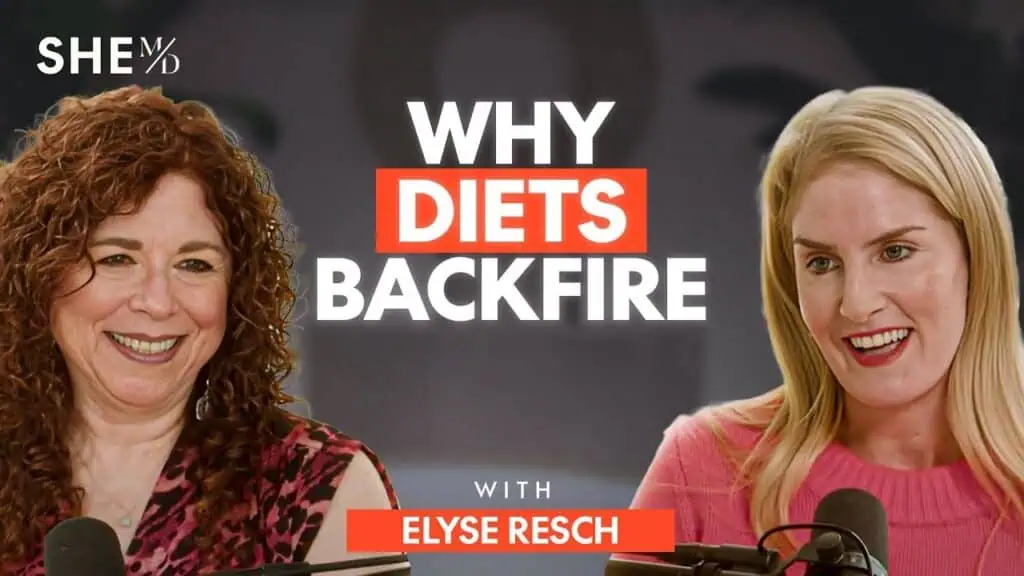
The conversation naturally moved into body image and food, and Whitney shared how meaningful intuitive eating has been in her life. She and Mary Alice both spoke about Elyse Resch, one of the pioneers of intuitive eating, and the freedom that comes from stepping away from rigid food rules.
Whitney described intuitive eating not as another framework for control, but as the opposite. It is about listening to your body, allowing enjoyment, reducing fear around food, and taking away the moral judgments that so often get attached to eating.
Mary Alice shared a powerful example from her own experience. When she confessed that all she wanted for dinner was chocolate-chip ice cream, Elyse Resch encouraged her to eat exactly that every night for weeks. The result was not chaos. It was released. Once the forbidden quality disappeared, the obsession lost its hold.
That is one of the central ideas of intuitive eating. Restriction often intensifies fixation. Permission can quiet it.
For women moving through pregnancy, postpartum, fertility treatment, or miscarriage, this matters. So many of those experiences already bring enough pressure around the body. Food does not need to become another battlefield.

If body image or control around health has become consuming, it can help to revisit your relationship with food through a more compassionate lens. That is not just emotionally healing. It can also make the fertility journey feel less punishing.
The fertility story Whitney never expected to have
Did you have trouble getting pregnant the first time?
No. And that is an important part of this story.
Whitney’s first pregnancy happened easily after coming off birth control. She conceived within a couple of months, and although she did not enjoy the pregnancy itself, it was medically healthy. She delivered her son, Sunny, on his due date, and he weighed eight pounds.
That history matters because secondary infertility and recurrent miscarriage can be especially disorienting. Many women think, “I got pregnant before, so surely it should happen again.” When it does not, the confusion can be immense.
About a year after her son was born, Whitney became pregnant again and miscarried around eight weeks. Then she miscarried again. And again. In total, she experienced five miscarriages, all after seeing a heartbeat.
That detail hit hard.
Once a heartbeat is seen, the risk of miscarriage usually drops significantly. So repeated losses after that point raise important medical questions and deserve a thorough workup. Dr. Aliabadi was very clear on that.
What happened after repeated miscarriages?
After multiple losses, Whitney’s OB suggested she see a fertility specialist. By that point, she was 35 and had gone through five miscarriages. She underwent IVF and had embryos created and genetically tested. She ended up with several embryos, including two girls and two boys, with the male embryos graded more strongly.
Then another blow came. Just before she was supposed to do an embryo transfer, she became extremely ill and could not proceed. The delay was not just logistical. It triggered an emotional collapse. After so many losses, the pressure of trying again felt overwhelming.
Anyone who has been through repeated miscarriage will recognize that moment. Sometimes the body is not the only thing exhausted. The mind is, too.

That was when surrogacy became a serious possibility. Whitney said it had been in the back of her mind already, but she had not fully let herself say it aloud. Her husband was the one who finally did.
And once he said it, another path opened.
Why surrogacy felt like the right next step
How did you decide to pursue a surrogate?
For Whitney, the decision came after a profound accumulation of grief, stress, and physical depletion. She had lost weight, was emotionally drained, and felt that carrying another pregnancy herself was off the table. Surrogacy was not a first choice born of convenience. It was a thoughtful response to trauma.
She and her husband found a surrogate they loved. Everything seemed promising. But as Dr. Aliabadi later explained, there were warning signs that should have prompted more caution. The surrogate was 39 years old, and while she had previous pregnancies, age still matters in a gestational carrier.
Whitney chose to transfer the female embryos first, even though they were not graded as strongly. Both transfers resulted in pregnancy, both had heartbeats, and both ended in miscarriage because of subchorionic hemorrhage, which is bleeding behind the gestational sac that can increase the risk of pregnancy loss.
After those losses, Whitney and her family stepped back for about a year. Eventually, she chose to do another egg retrieval with a different doctor at age 39. That cycle resulted in one healthy male embryo. She also still had the remaining earlier embryos, but her doctor recommended prioritizing the newly created one.
At that point, she was back in the process of searching for a new surrogate, now much more informed than before.
Dr. Aliabadi’s fertility masterclass: the buckets every woman should know
You broke fertility evaluation into “buckets.” Why is that framework so important?
Fertility care can feel fragmented, confusing, and overly dependent on individual providers. Dr. Aliabadi’s framework is useful because it turns a vague process into a checklist. Instead of accepting “unexplained” too early, we can ask whether each major category has truly been evaluated.
If you are trying to understand fertility problems, recurrent miscarriage, or IVF failure, this structure is worth knowing.
For a broader overview of the diagnostic process, this fertility testing guide is a helpful companion resource.
Bucket 1: What is the female factor?
This bucket includes the person producing the eggs and covers:
- Egg count
- Egg quality
- Hormone levels
- Thyroid function
- Testosterone
- Prolactin
- General ovulatory function
- Screening for infections or sexually transmitted infections where relevant
In Whitney’s case, the fact that she was making embryos suggested that some aspects of this bucket were working. But normal does not always mean complete. Dr. Aliabadi later pointed out that producing a large number of eggs at 39 can sometimes raise the question of whether PCOS is being missed.
Bucket 2: What is the male factor?
This bucket concerns sperm quality and semen analysis. If a couple has achieved pregnancy before, there is already some reassurance that sperm function is sufficient, though in some cases further analysis may still be needed.
The key point is that fertility should never be framed as only a female issue. A full evaluation includes both sides.
Bucket 3: What about the uterus, tubes, and anatomy?
This is the structural bucket, and it is a big one. It includes questions like:
- Is the uterine cavity normal?
- Are there fibroids?
- Are there uterine polyps?
- Is there a septum dividing the uterus?
- Are the fallopian tubes open?
- Is there adenomyosis in the uterine wall?
Dr. Aliabadi emphasized adenomyosis in particular. This condition involves endometrial-like tissue growing into the muscular wall of the uterus. It can increase the risk of miscarriage and is often missed, even in fertility settings.
She explained that in some patients, the wall of the uterus becomes less hospitable to pregnancy and can effectively push pregnancies out. When adenomyosis is found, she may recommend suppressing it before embryo transfer, often with a Lupron shot several weeks in advance.
This bucket may also include imaging such as ultrasound, hysterosalpingogram, or saline sonography, depending on the clinical picture.

If there is a polyp, it may need to be removed. If fibroids distort the uterine cavity, they may need treatment. If a septum is present, it may need surgical correction. If hydrosalpinx is found, meaning fluid-filled, damaged fallopian tubes, this can also impair implantation or increase miscarriage risk.
Bucket 4: Where does PCOS fit in?
PCOS, or polycystic ovarian syndrome, is often associated with irregular cycles, acne, excess facial or body hair, hair loss, and insulin resistance. But Dr. Aliabadi pointed out something many women do not realize: some patients with PCOS may appear “lean” and even have fairly regular periods, yet still not be ovulating optimally.
She highlighted how underdiagnosed PCOS remains and how important it is to catch it early. Patients with PCOS often have many eggs, but the quality can decline significantly with age, which affects embryo quality and pregnancy outcomes.
For women who suspect hormonal symptoms have been overlooked, or whose cycles seemed “fine” only because they were on hormonal contraception for years, this article on birth control masking fertility issues may be useful.
Bucket 5: Why is endometriosis such an important fertility issue?
Endometriosis is one of the biggest examples of a condition being underdiagnosed despite how common and disruptive it is. It can affect fertility in several ways:
- It may lower egg count and egg quality
- It can create inflammation in the pelvis
- It may scar or damage the fallopian tubes
- It may interfere with the egg being picked up by the tube
- It can coexist with adenomyosis, increasing the risk
One of Dr. Aliabadi’s strongest points was that the amount of pain a woman feels does not reliably predict how much endometriosis she has. Some women with severe disease do not report dramatic symptoms, especially if they have spent years on birth control pills that suppressed the condition.
That means endometriosis can be hiding inside the category of “unexplained infertility.”
If this possibility has ever been brushed aside in your own care, this endometriosis resource explains the condition in more depth.
Bucket 6: What role do autoimmune issues play in recurrent miscarriage?
This was one of the most striking parts of the conversation.
Dr. Aliabadi said that when someone has repeated miscarriages after a heartbeat, especially with tested embryos, an autoimmune component needs to be taken very seriously. Even if the standard autoimmune panel is negative, she still thinks clinically.
Her concern is that the body may be recognizing the pregnancy as foreign and mounting an immune response. In simple terms, blood clots can form in the tiny vessels that support the pregnancy, leading to loss.
That is where blood thinners can make a major difference.
Why did blood thinners come up so strongly in this conversation
Why were you so surprised that Whitney had never been offered Lovenox?
Because in Dr. Aliabadi’s view, recurrent losses with heartbeats should trigger a much more aggressive prevention strategy. She said plainly that if a patient has had multiple miscarriages at that stage, she often uses blood thinners such as Lovenox, along with a broader supportive protocol.
That protocol may include:
- Lovenox
- Baby aspirin
- Progesterone support
- Pepcid
- Claritin
She referred to it as the “kitchen sink” approach, meaning that when the cost of missing something is repeated pregnancy loss, she would rather support the pregnancy from multiple angles than sit back and hope.
She was also clear that advanced maternal age pregnancies should generally be on baby aspirin from 12 to 36 weeks to reduce the risk of preeclampsia, assuming there are no contraindications and the pregnancy has progressed to that stage.

This part of the conversation is not a substitute for personalized medical care, but it is a powerful example of why recurrent miscarriage deserves expertise, urgency, and a willingness to think beyond generic lab panels.
For women looking specifically for more information on recurrent pregnancy loss and treatment options, including anticoagulation in some cases, this recurrent miscarriage article is a valuable place to continue reading.
The hard truth about choosing a surrogate
What should intended parents know when selecting a surrogate?
Dr. Aliabadi did not sugarcoat this. She said she is extremely selective when it comes to gestational carriers, and she explained why.
Her preferences include:
- Ideally under age 32
- No previous C-sections
- A history of healthy, appropriately grown full-term babies
- No major pregnancy complications such as postpartum hemorrhage or hypertensive disorders
- Careful review of actual hospital delivery records, not just verbal history
That last point matters. A surrogate may sincerely believe she had normal pregnancies, but the official records can reveal important details such as hemorrhage, transfusion, growth restriction, preterm birth, or recurrent subchorionic bleeding.
In Whitney’s case, she later learned that the surrogate had experienced the same type of bleeding complication in a prior pregnancy, even though that pregnancy ultimately ended with a healthy baby.
Those are the kinds of details that can shape decision-making in a major way.

For intended parents, the takeaway is simple but not easy: emotion matters, but records matter too. Loving someone is not enough. You also need a medically careful match.
Advocacy, second opinions, and the phrase women hear too often: “You’re fine.”
What was the larger lesson in all of this?
Whitney said something so many women feel. Often, the common denominator in these stories is not just the diagnosis. It is the provider experience.
That does not necessarily mean a doctor is uncaring or incompetent. Sometimes the issue is that medicine is complex, care is rushed, and no one is taking the full picture seriously enough. But when the result is years of confusion, repeated loss, or missed diagnoses, women are still the ones living with the consequences.
That is why the conversation kept returning to advocacy.
Know the questions to ask. Understand the categories that should be evaluated. If your concerns are brushed off, get another opinion. If a doctor tells you “everything looks normal,” but your experience says otherwise, keep going.
Whitney reflected that she had chosen to focus almost exclusively on following one doctor’s lead, partly to avoid getting overwhelmed by too much outside input. That is understandable. But she also recognized that there can be a downside to staying too closed off. More information, when it is reliable and specific, can be empowering.
That is exactly why women need access to clear education about their own bodies.
What did Dr. Aliabadi want Whitney to hear most?
Hope.
Not vague hope. Not performative optimism. Real, specific hope.
Dr. Aliabadi told Whitney that she believed she would have another baby. She said Whitney had already completed most of the puzzle and was likely missing a smaller percentage of key information or management that could change the outcome.
For anyone in the middle of infertility or recurrent loss, those words can land deeply. Sometimes what a person needs most is not a guarantee, because medicine cannot promise that. What they need is a knowledgeable doctor willing to say, “I still see a path.”
The emotional reality behind fertility treatment
What made Whitney’s story especially powerful?
It was not only the facts of the case. It was how openly she showed the emotional texture of it.
She cried while talking about the transfers that failed. She described the mental breakdown before transfer. She admitted the regret that crept in after hard decisions. She spoke about how telling the story itself can be painful, especially when it is not something you revisit every day.
That honesty matters because fertility treatment can become incredibly procedural. Counts, grades, protocols, shots, retrievals, transfers, tests. It is very easy for the human being inside the process to disappear behind the medical language.
Whitney brought the human being back into the center of it.
And by doing that, she gave language to the silence so many women carry.

A few lighter moments that still felt very real
After such a heavy conversation, how did things shift at the end?
Like many good conversations between women, this one made room for seriousness and softness at the same time.
After discussing miscarriage, fertility workups, autoimmune concerns, and surrogacy, the tone gently shifted to skincare. It was a reminder that women are never just one thing. We can be in the middle of grief and still care about what makes us feel glowy. We can talk about embryo grading and foundation in the same hour. That is not trivial. It is human.
Whitney shared that she has always taken care of her skin and mentioned a few products she loves, including a CC cream with SPF 50 and a face mist she keeps in her purse. It was a small moment, but a sweet one. It allowed everyone to exhale a little.
And honestly, that felt right. Conversations about women’s health do not have to live in one emotional register. They can hold pain, expertise, humor, beauty, and hope all at once.
What we want women to take away from this conversation
If someone is dealing with miscarriage or infertility right now, what should they remember?
There were a few big takeaways we kept returning to:
- Repeated miscarriage is not something to minimize. Especially after a heartbeat, it deserves a serious and comprehensive evaluation.
- “Unexplained” should not be the end of the conversation too early. Sometimes it means the right questions have not yet been asked.
- Fertility workups need structure. Female factor, male factor, uterine anatomy, PCOS, endometriosis, and autoimmune causes should all be considered.
- PCOS and endometriosis are often missed. Do not assume the absence of a diagnosis means absence of disease.
- Autoimmune-related miscarriage can exist even with negative standard testing. Clinical judgment matters.
- Surrogate selection should be medically rigorous. Actual records matter more than assumptions.
- You are allowed to seek another opinion. In fact, sometimes you should.
- There is power in telling the truth about what you are going through. Silence protects shame more than it protects you.
Most of all, we want women to hear this: you are not difficult to ask more questions. You are not dramatic for wanting a deeper explanation. You are not failing because your path to motherhood is complicated.
You deserve care that is thoughtful, thorough, and rooted in real expertise.
FAQs
What is recurrent miscarriage?
Recurrent miscarriage generally refers to multiple pregnancy losses, often two or more clinically recognized miscarriages. In this conversation, the focus was on repeated losses after a heartbeat had already been seen, which raises important medical questions and warrants a thorough evaluation.
Why does it matter if a heartbeat was seen before a miscarriage?
Once a heartbeat is detected, the risk of miscarriage usually drops. When losses continue to happen after that point, clinicians should think carefully about other causes, including uterine issues, embryo quality, endometriosis, adenomyosis, clotting disorders, and autoimmune-related problems.
What are the main categories that should be checked in a fertility workup?
Dr. Aliabadi described six key buckets: female factor, male factor, uterine and tubal anatomy, PCOS, endometriosis, and autoimmune causes. Looking at fertility this way helps patients understand whether the evaluation has truly been comprehensive.
Can PCOS be missed even if periods seem normal?
Yes. Some women with PCOS are lean and may even appear to have regular cycles, but they may not be ovulating optimally. PCOS can affect egg quality and embryo development, especially as women get older.
Can endometriosis cause infertility even without severe pain?
Yes. The severity of pain does not always match the severity of the disease. Some women with significant endometriosis may have relatively subtle symptoms, especially if years of hormonal birth control suppressed the condition.
Why are blood thinners sometimes used after recurrent miscarriage?
In some patients, especially those with repeated losses after heartbeat or suspected immune-related pregnancy loss, blood thinners such as Lovenox may help by reducing clotting in the tiny vessels that support the pregnancy. This decision must be individualized by a qualified physician.
What should intended parents look for in a surrogate?
Important factors include age, pregnancy history, mode of prior deliveries, full-term healthy birth history, lack of major complications, and full review of hospital records. A warm personal connection matters, but medical history matters just as much.
What is intuitive eating?
Intuitive eating is an approach that moves away from rigid diet rules and helps people reconnect with internal hunger, fullness, satisfaction, and body cues. It encourages flexibility and can be especially freeing for women who have struggled with food control or body image.
When should someone seek a second opinion in fertility care?
If you have had repeated miscarriages, feel your concerns are being minimized, have been told everything is “normal” without a clear explanation, or suspect conditions like endometriosis, PCOS, adenomyosis, or autoimmune factors have not been fully explored, a second opinion can be very appropriate.
Whitney’s story is still unfolding, but what she shared already carries real weight. It reminds us that motherhood is not always linear, fertility care is not always complete on the first pass, and women often have to become experts in their own experience before the system starts listening.
We hope this conversation helps more women ask sharper questions, find better care, and hold on to hope when the road has been much longer than expected.
Concerned About Your Health? Talk to Dr. Aliabadi
Dr. Aliabadi is an expert OB/GYN who is knowledgeable in all aspects of women’s health and well-being. Dr. Aliabadi and her caring, supportive staff are available to support you through PCOS, endometriosis, menopause, childbirth, infertility, or routine gynecological care. We invite you to establish care with Dr. Aliabadi. Call us at (844) 863-6700 or
This article was created from the video Navigating Miscarriages, Fertility, and Motherhood with Whitney Port Rosenman | SHE MD for Dr. Thais Aliabadi’s website.